|
We can’t wait to tell you all about it! ͏ ͏ ͏ ͏ ͏ ͏ ͏ ͏ ͏ ͏ ͏ ͏ ͏ ͏ ͏ ͏ ͏ ͏ ͏ ͏ ͏ ͏ ͏ ͏ ͏ ͏ ͏ ͏ ͏ ͏ ͏ ͏ ͏ ͏ ͏ ͏ ͏ ͏ ͏ ͏ ͏ ͏ ͏ ͏ ͏ ͏ ͏ ͏ ͏ ͏ ͏ ͏ ͏ ͏ ͏ ͏ ͏ ͏ ͏ ͏ ͏ ͏ ͏ ͏ ͏ ͏ ͏ ͏ ͏ ͏ ͏ ͏ ͏ ͏ ͏ ͏ ͏ ͏ ͏ ͏ ͏ ͏ ͏ ͏ ͏ ͏ ͏ ͏ ͏ ͏ ͏ ͏ ͏ ͏ ͏ ͏ ͏ ͏ ͏ ͏ ͏ ͏ ͏ ͏ ͏ ͏ ͏ ͏ ͏ ͏ ͏ ͏ ͏ ͏ ͏ ͏ ͏ ͏ ͏ ͏ ͏ ͏ ͏ ͏ ͏ ͏ ͏ ͏ ͏ ͏ ͏ ͏ ͏ ͏ ͏ ͏ ͏ ͏ ͏ ͏ ͏ ͏ ͏ ͏ ͏ ͏ ͏ ͏ ͏ ͏ ͏ ͏ ͏ ͏ ͏ ͏ ͏ ͏ ͏ ͏ ͏ ͏ ͏ ͏ ͏ ͏ ͏ ͏ ͏ ͏ ͏ ͏ ͏ ͏ ͏ ͏ ͏ ͏ ͏ ͏ ͏ ͏ ͏ ͏ ͏ ͏ ͏ ͏ ͏ ͏ ͏ ͏ ͏ ͏ ͏ ͏ ͏ ͏ ͏ ͏ ͏ ͏ ͏ ͏ ͏ ͏ ͏ ͏ ͏ ͏ ͏ ͏ ͏ ͏ ͏ ͏ ͏ ͏ ͏ ͏ ͏ ͏ ͏ ͏ ͏ ͏ ͏ ͏ ͏ ͏ ͏ ͏ ͏ ͏ ͏ ͏ ͏ ͏ ͏ ͏ ͏ ͏ ͏ ͏ ͏ ͏ ͏ ͏ ͏ ͏ ͏ ͏ ͏ ͏ ͏
|
What do potable water projects, women’s weaving, scholarships, English language learning, food security, revitalization of the Aymara language and culture, Alternatives to Violence workshops, greenhouses in prisons, and a boarding house for rural high school students have in common? They are all Bolivian initiatives with connections to Friends in the US and in the UK!
|
|
|
|
|
|
|
Dearest F/friends, Thank you for your generous end-of-the-year donations!! We started this year off with a Quaker Study Tour and 22 scholarship students. This is our second year collaborating with Magaly Quispe of AVP/PAV Bolivia to offer basic and advanced Alternatives to Violence (AVP) workshops for our scholars and graduates. AVP supports their emotional and spiritual well-being and brings them together, creating community while strengthening Quaker values. Our increased communication and connections with graduates and their organizations are generating new ideas for improving the quality of our programs in Bolivia. This year, BQEF is offering a stipend for a pre-professional internship with AVP/PAV Bolivia (Magaly Quispe). With your help, we would like to do the same with Quaker Bolivia Link - Bolivia (Efrian Cotjiri), Friends International Bilingual Center (Emma Condori), and Jaqi Aru (Ruben Hilari). For many of our scholars, internships are required for graduation, and they involve research that could be helpful to the host organizations. Moreover, they give scholars an opportunity to acquire experience in their field while strengthening connections with organizations founded by BQEF scholarship recipients.
|
|
During this year’s Quaker “Connections” Study Tour, January 7-20th, we visited seven very distinct organizations of Bolivian F/friends. We were blessed with an amazing group of 10 Quakers from across the U.S., including representatives from Quaker Earthcare Witness, Friends Journal, Western Friend, the co-pastor from Fairfield Friends Meeting, IN, The Quaker House, in Fayetteville N.C., three alumni from Quaker Voluntary Service, and BQEF volunteers. We’re excited to share what we’ve learned, show you the beautiful connections we made with Bolivian F/friends, and some exciting possibilities for collaboration. Blessings to all of those who are standing up to the injustices within our country and abroad. Surrounding you in a bubble of light and love, Rebecca Day Cutter, BQEF Coordinator
|
|
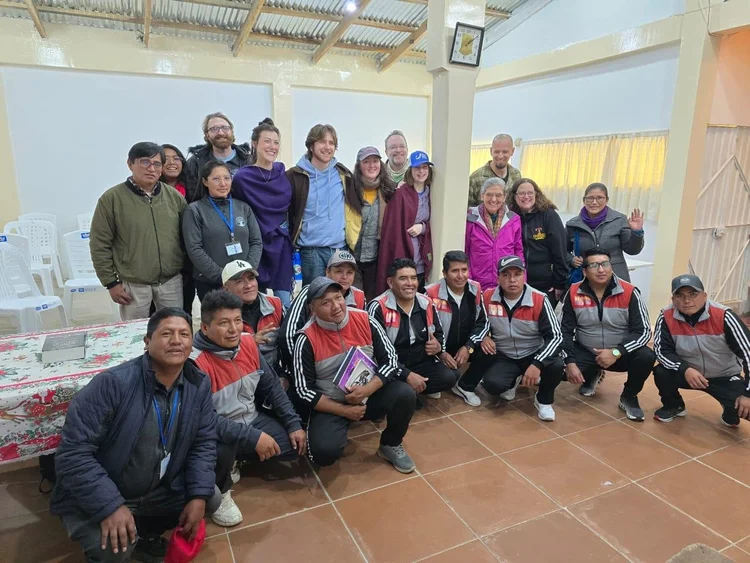
The “silly” group picture after our Apthapi, Andean potluck, with the Fundación Quakera de Educación en Bolivia, FQEB staff, board, and a handful of our current scholars. We arrived in La Paz on the second day of a six-day nationwide protest that blocked major roads. Sadly, our plans to acclimate in Sorata and visit PAV Bolivia’s boarding house were canceled. While adapting to 12,000 feet in La Paz, we gathered perspectives on the country’s socio-economic and political crisis. President Rodrigo Paz issued a decree enacting nearly 100 laws, including the removal of gas subsidies, without adequate consultation with social movement and labor leaders.
|
|
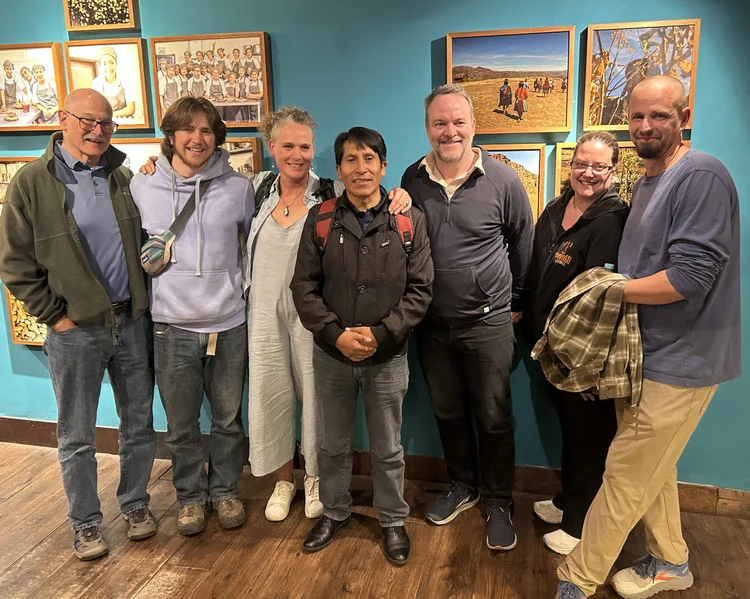
Ruben Hilari Quispe, former BQEF scholarship student and now Vice Minister of Employment, Civil Service, and Cooperatives, participated in the negotiations between the government and leaders from social movements. Somehow, he made time for a dinner debrief with our group, helping us understand the nuances of Bolivia’s history and its current situation. |
|
|
|
Thankfully, the negotiations were fruitful, and we were able to travel outside of La Paz to visit Quaker Bolivia Link potable water projects with Efrain, and the Chonchocoro, Maximum Security Prison, with Magaly. We also spent two glorious days disconnected from technology on the shores of Lake Titicaca in Santiago de Okola. Our last excursion was to Ruben’s village, Walata Chico, where we were greeted with much love and affection. In La Paz and El Alto, we spent a day with Emma, learning about her work at the Friends International Bilingual Center, with Ruben’s organizations, which promote Aymara culture and language, with Las Gregorias Weaving Coop, and the Friends World Committee For Consultation, Section of the Americas (FWCC-in Bolivia). We hope you will enjoy this report, and please reach out to us to help support our work. We can direct you to organizations that fund specific projects. If you are interested in attending our January 2027 Quaker Study Tour, please fill out the following inquiry form.
|

|
“Jiwasa is a fundamental principle and linguistic code in the Aymara language that means “communal we.” In many ways, it relates to Quaker testimonies: community, integrity, peace, and harmony with nature.” |
|
|
|
If you haven’t already read Ruben’s piece, “Jiwasa: the Communal We,” published by Friends Journal, January 1, 2026, translated by Renzo Mejia Carranza, or heard the Quakers Today podcast interview with Ruben, you have something to look forward to! Check the news section at bqef.org for links to both.
|
|
We visited the offices of Ruben’s two nonprofits, Jaqi Aru and Qillqa Uta. He explained Jiwasa, the communal “we,” and his work to reinsert important Andean concepts into Bolivian society through the publication of books and through political participation.
|
|
On our very last day of the tour, we traveled to Walta Chico, Ruben’s hometown, to meet with, seemingly, the entire community, but specifically with the poncho rojo community leaders, makers of native musical instruments, weavers, and farmers. It was beautiful to see how proud his community is of his accomplishments. There was live music, dancing, food, and workshops on weaving and food sovereignty. With their help, he is turning his childhood home into a cultural museum. (Pic: Caitlin Churchill, Editor of Western Friend, in Walata Chico.)
|
|
|
|
|
|
|
Magaly Quispe Yujra, top left, with BQEF scholarship students after the basic AVP course. Jackson Napier, top row, middle, is the co-pastor of the Fairfield Friends Meeting, Indiana. Jackson joined the QST after co-facilitating the AVP training with Magaly and her team. We first saw Magaly and AVP/PAV Bolivia in action at the closing celebration of an AVP course with BQEF scholarship students. After which, a handful of scholars accompanied us to the Ethnography Museum. This was a great way to get to know our scholars! From then on, we invited scholars to join us for several of our excursions.
|
|
Photo: current BQEF scholar, Ruth Apasa Huanca (studying medicine), pointing out the location of her Afro-Bolivian community at the Ethnography museum. Once the blockades ended, we went to Chonchocoro, Bolivia’s maximum-security prison, for the inauguration of two greenhouses built by the privados de libertad, people deprived of liberty, with support from Quaker Bolivia Link. Magaly and her team have led AVP trainings in most of Bolivia’s prisons, earning the respect and affection of privados de libertad and the prison staff.
|
|
Photo: visit with privados de libertad in the Chonchocoro Prison.
|
|
Quick footnote: QBL-UK, established in 1995, was the first Quaker organization to support projects in Bolivia; later came QBL-US. After decades of work in solidarity with Bolivia, both QBL-UK and QBL-US laid down their operations. The QBL - Bolivia office in La Paz continues delivering potable water projects, greenhouses, and other projects with support from United 4 Change and Rotary International.
|
|
One of our big, beautiful adventures was a trip to the highlands with Efrian Cotijri, the technical engineer responsible for the construction of QBL’s water, sanitation, and agricultural projects. The reception line, with one warm welcome after another, and the abundance of food at the two Apthapis, left us feeling awe for their incredible generosity. Photo: Jesse Schoch, BQEF Volunteer, making good use of the community’s vital liquido, its vital liquid.
|
|
|
|
|
|
|
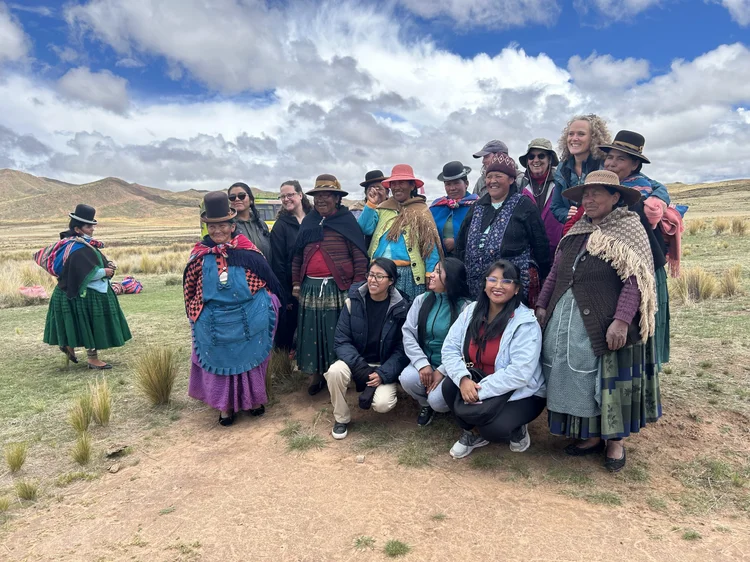
Love is a two-way street; appreciate, participate, and reciprocate. In an official act, Penny Thron-Webber, BQEF Clerk, was named godmother of the Chipanamaya school, with all of its 8 students. She graciously accepted their request for school supplies. The QST group as a whole received a formal request to help fund the final connections of potable water lines to the homes of 15 families. If you would like to help, please reach out to info@bqef.org for more information. Picture: “Just the Ladies,” in the community of Ayllu Jiraphi Alto, site of QBL potable water project, with three BQEF scholars in the front row.
|
Friends International Bilingual Center
|
|
Emma Condori hosted our group at the Friends International Bilingual Center (FIBC) in La Paz, where she presented on her organization’s English, Spanish, and Aymara classes and service learning opportunities. The slide in the picture depicts the food security work she began in 2023, when a drought caused crop failure, and many Bolivians went hungry.
|
BQEF would love to subsidize English and Aymara classes for our scholarship students so that they can spend time learning with Emma while acquiring new languages and also participating in her food security service work. Emma joined us for dinner at our Airbnb to give Jonny Costello, from Quaker Earthcare Witness, a signed copy of her book. Emma’s book can be purchased through Pendle Hill Bookstore. |
|

|
|
Las Gregorias Weaving Cooperative
|
|
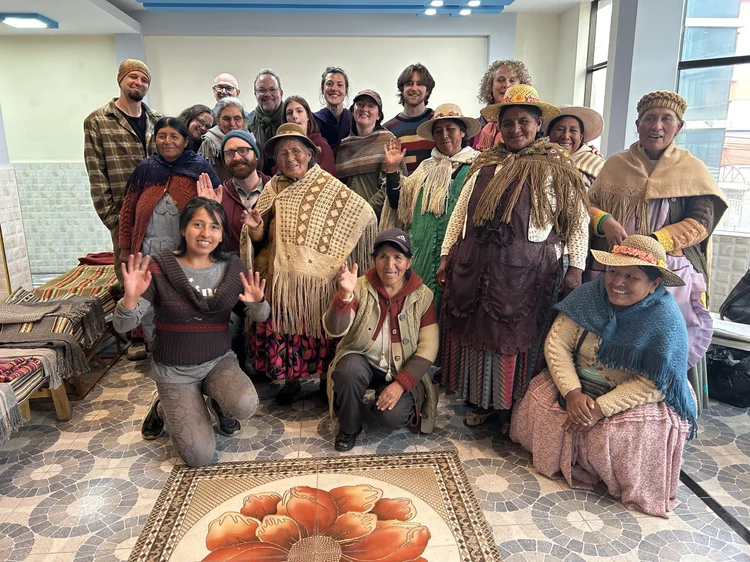
Antonia Apaza, the cooperative’s secretary, showed how she uses different weaving machines and a foot-pedal loom to create beautiful alpaca textiles. The cooperative is now a small group of elders who weave at home and sell their work through a fair-trade store in La Paz. In their origin story, they mentioned support from QBL‑UK to buy equipment. It was a joy to visit them and to buy their woven pieces.
|
FWCC Section of the Americas in Bolivia
|
|
Photo: at the CMCA (Committee Mundial de Consulta de los Amigos) event, we encountered six former scholarship students who are now professionals working in various fields. Juan Aparicio, second from the right, is the FQEB board president, and Alicia Lucasi, second from the left, works for FQEB as their program coordinator. Representatives from CMCA hosted us at the Bella Vista Evangelical Church, which is part of the Amigos Central Yearly Meeting, with a full agenda of get-to-know-you games, presentations on their work, and ours. The event turned into a wonderful opportunity to share information about our scholarships with more youth and for the QST groups to share the diverse ways they live their faith in action. We ended the evening with dinner and more conversation with CMCA members. We hope you have enjoyed this report! Use the Facebook and Instagram links below to see more pictures from our trip to Bolivia. Many Blessings from BQEF Last photo: left to right, Gabriel Ehri, executive director, Friends Publishing Corporation, Jesse Wolf, actor and granddaughter of Penny and Bruce Thron-Webber, Lucia De Blanco, our wonderful interpreter guide, and Jonny Costello, from Quaker Earthcare Witness.
|
|
|
|